01
Noise
Adaptive suppression that kills the room, not the take. No learn button, nothing to arm — it just listens.
Tap for the full story
BADSCANDAL audio · vocal chain
The all-in-one vocal chain, made by engineers.
50% off for the first 300 buyers
Instant key by email · 2 machines · works offline
What it is
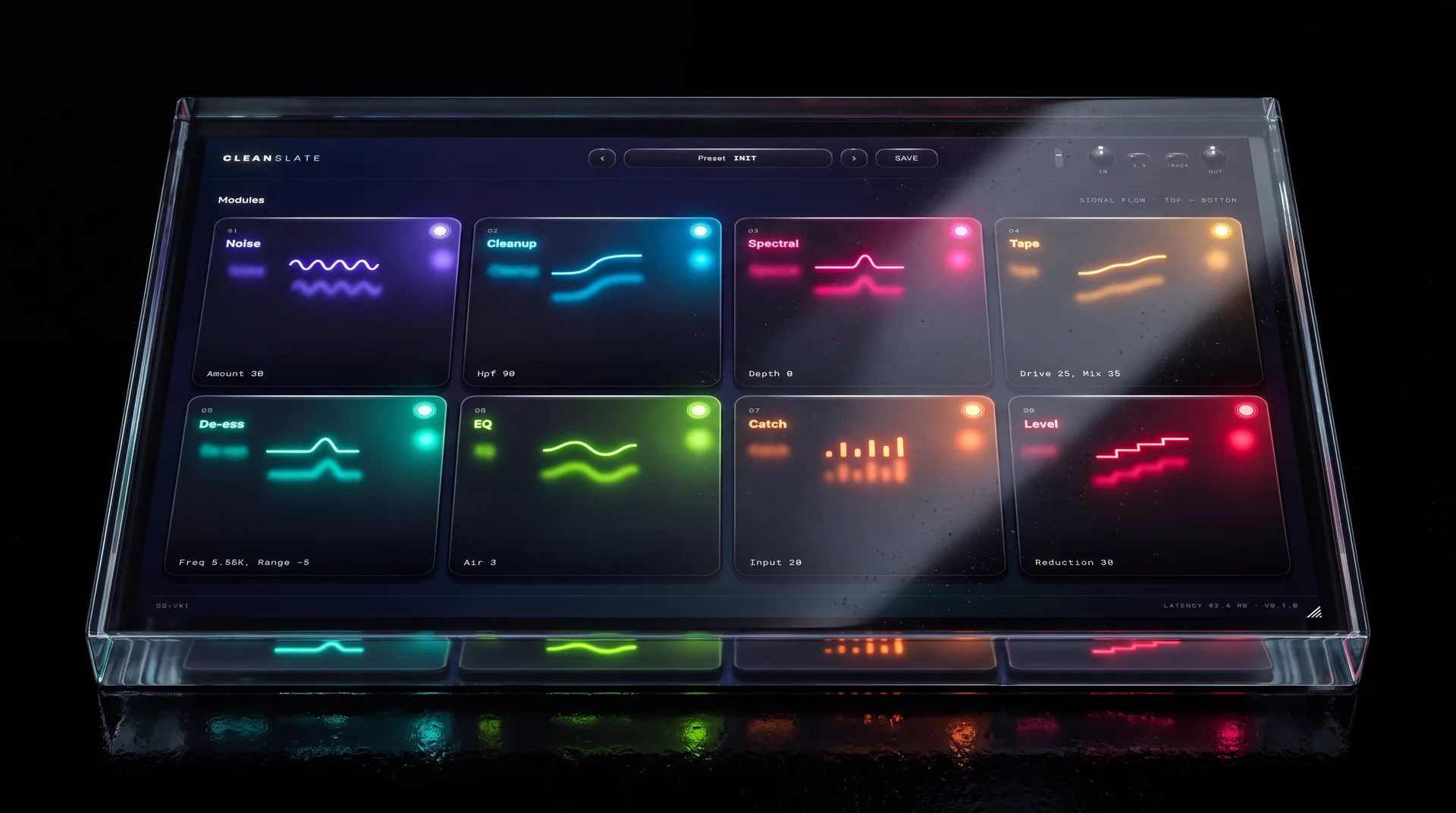
CLEANSLATE is a complete vocal chain in the order a professional session runs it: noise suppression, cleanup, spectral resonance control, tape saturation, de-essing, a surgical EQ and two stages of compression, in a single window with the signal flowing top to bottom.
Every module is modelled on the analogue compressors and spectral processors engineers reach for, then tuned specifically for vocals rather than shipped as a general-purpose effect. Spectral knows the regions where a voice builds resonance and listens for them in your take; if it finds nothing, it removes nothing. The compressors, the noise suppression and the de-esser follow the same principle: prepared for the voice, acting only when the voice calls for it, with every parameter still under your control.
Switch on TRACK and the chain drops to 10.7 ms of latency, so the same processing that finishes a vocal can be sung through live.
Signal flow · top to bottom
01
Adaptive suppression that kills the room, not the take. No learn button, nothing to arm — it just listens.
Tap for the full story
02
High-pass, low-pass and the mud filter. The stuff you do on every vocal, done before you have to think about it.
Tap for the full story
03
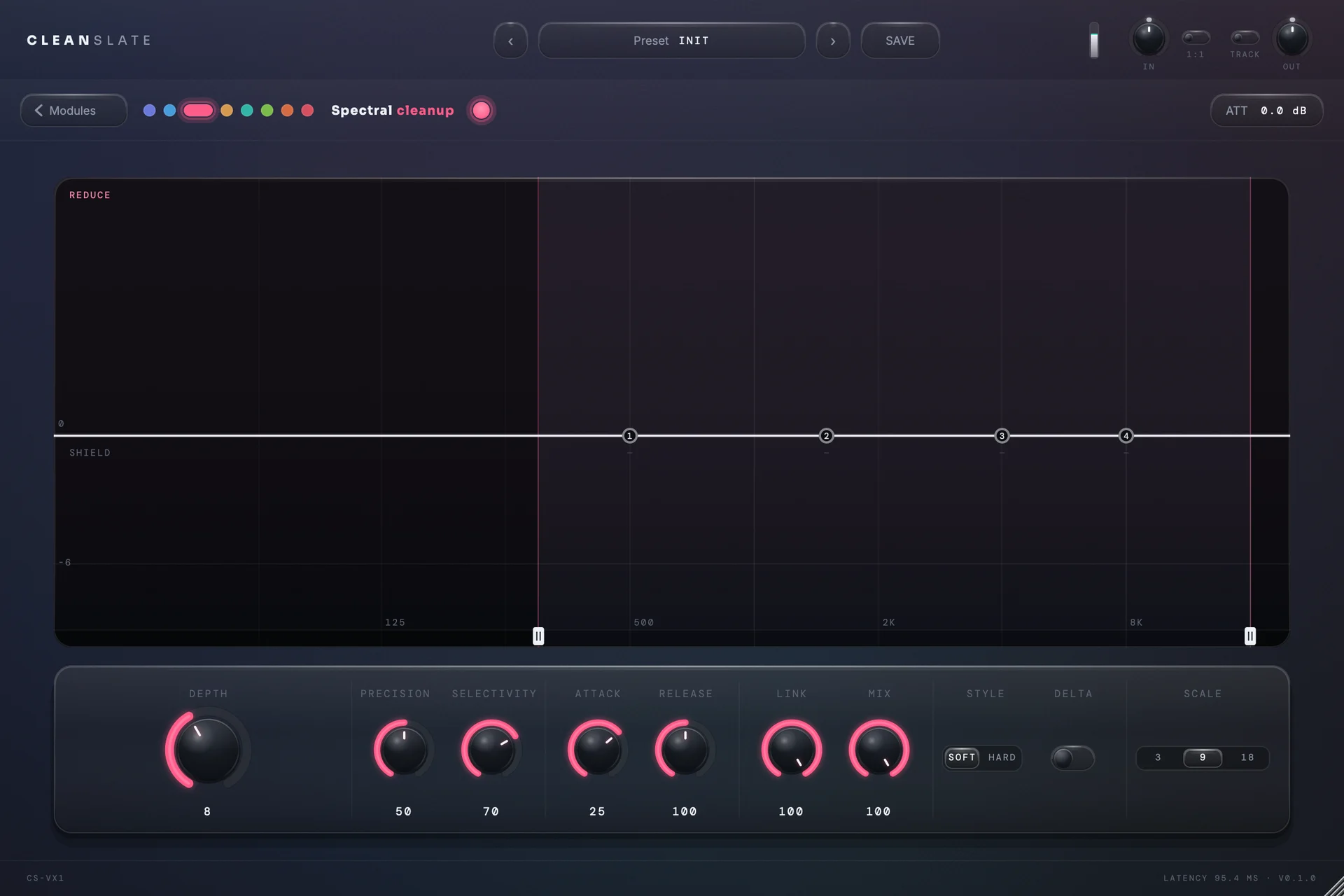
Resonance control with four nodes and a live reduction burn. Boxiness, harshness and mic ring, carved out as they appear.
Tap for the full story
04
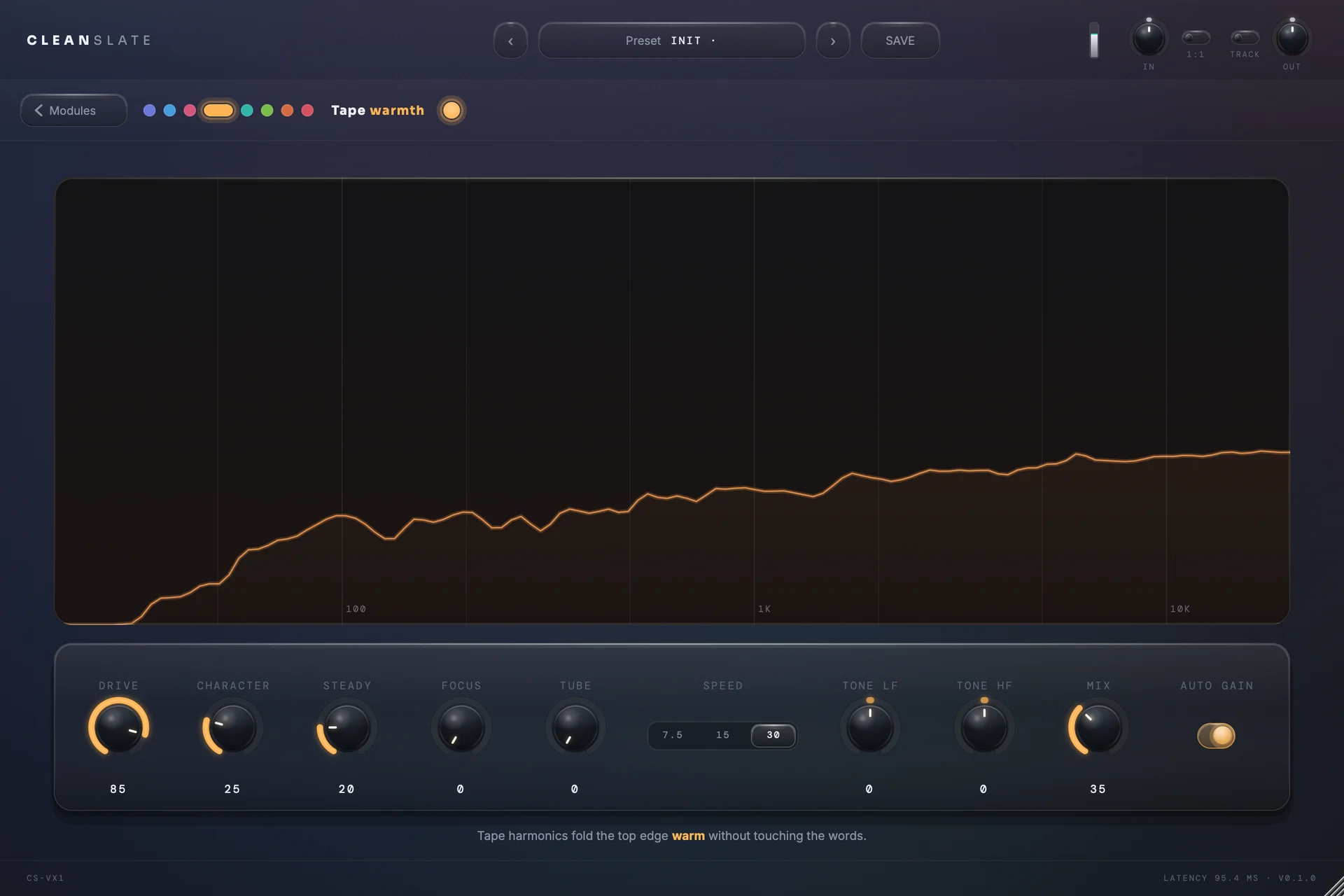
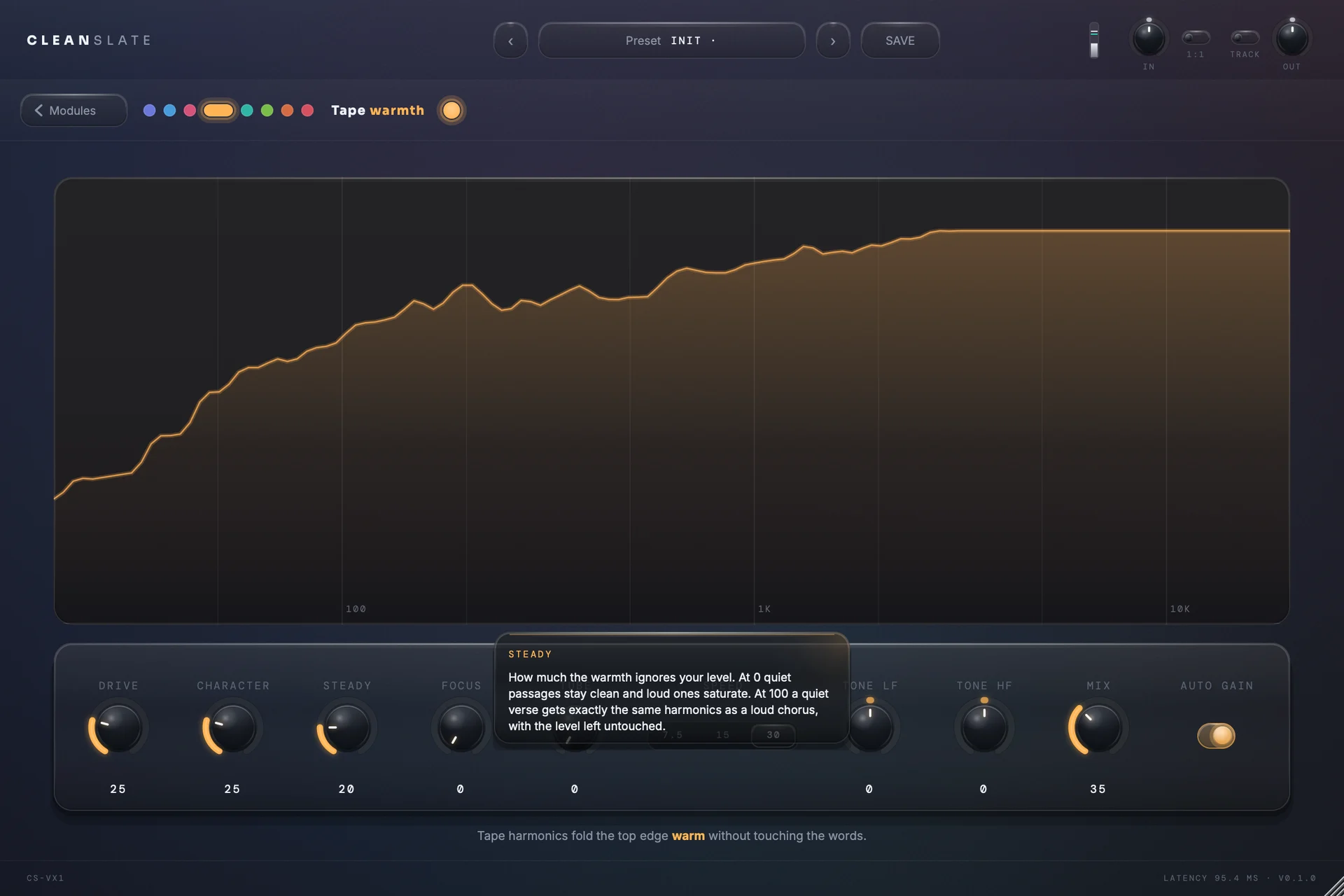
Oversampled tape saturation with Character, Steady, Focus and Tube. Level-invariant, so quiet takes get the same glow.
Tap for the full story
05
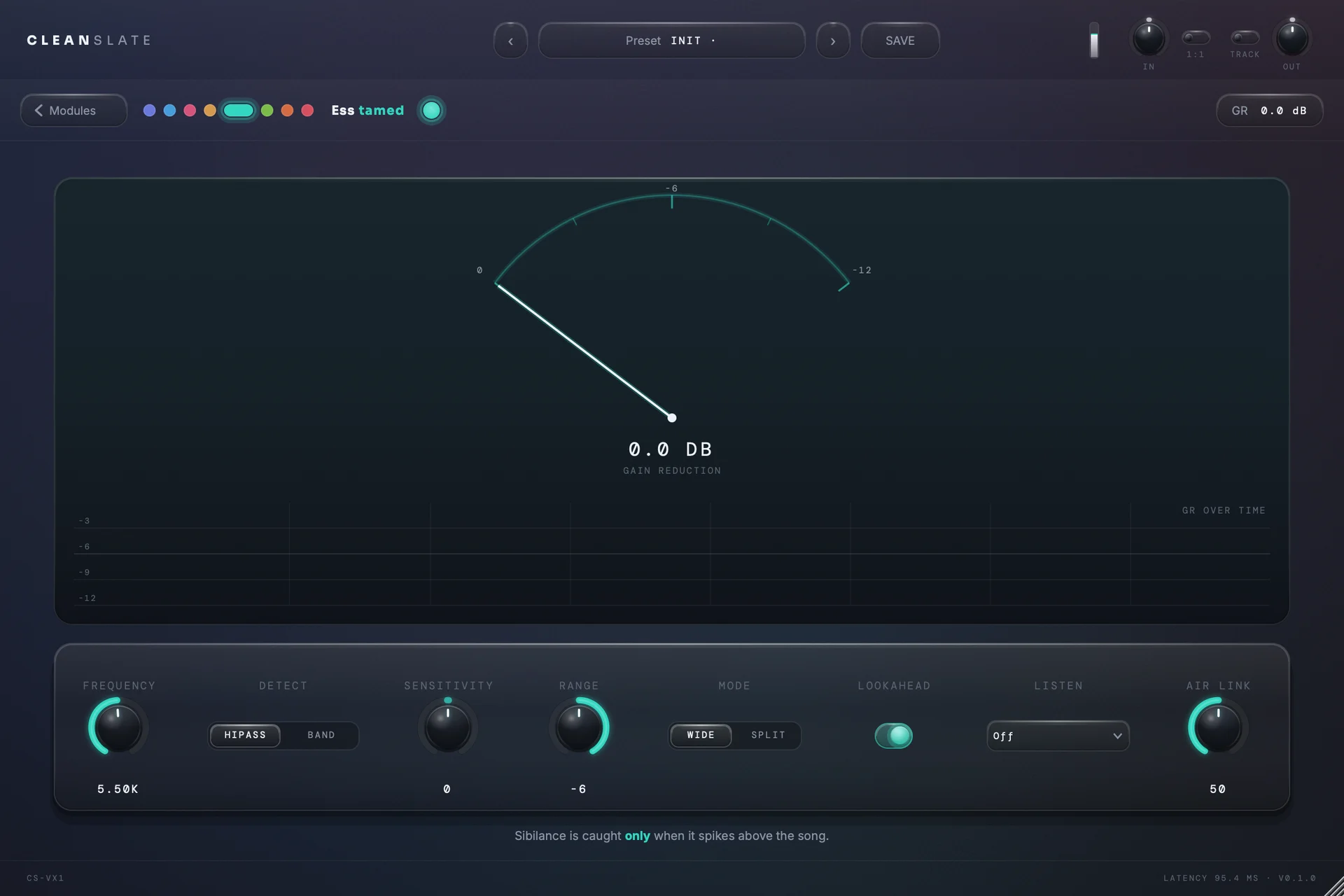
Adaptive threshold, no attack, no release, no lisp. Wide or split, it only ever touches the ess.
Tap for the full story
06
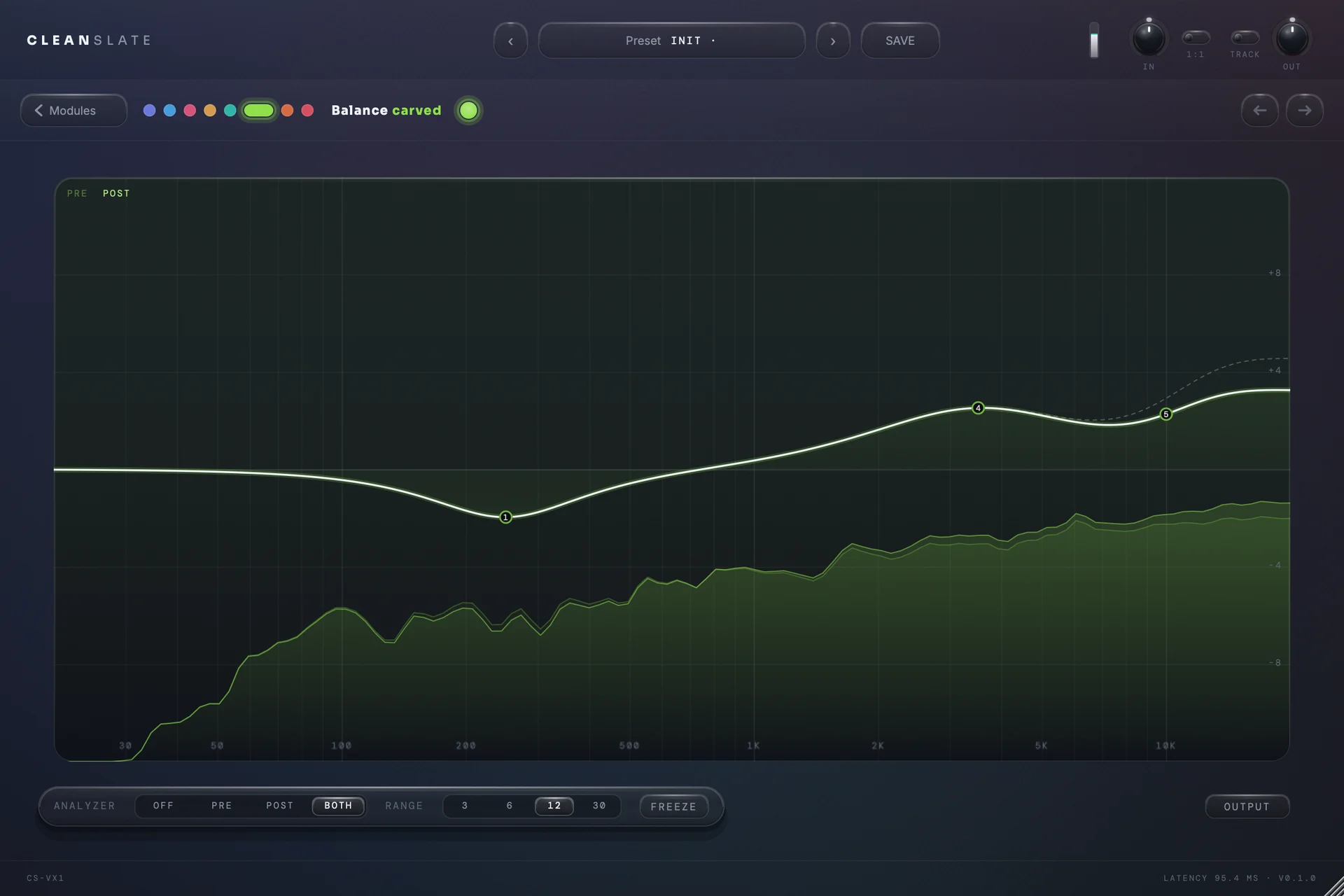
Twelve surgical bands, ten shapes, slopes to 96 dB, per-band dynamics. Air Link lifts the top as the de-esser works.
Tap for the full story
07
A FET compressor in the classic fast style: grabs the peaks, adds the grit, holds the vocal in front.
Tap for the full story
08
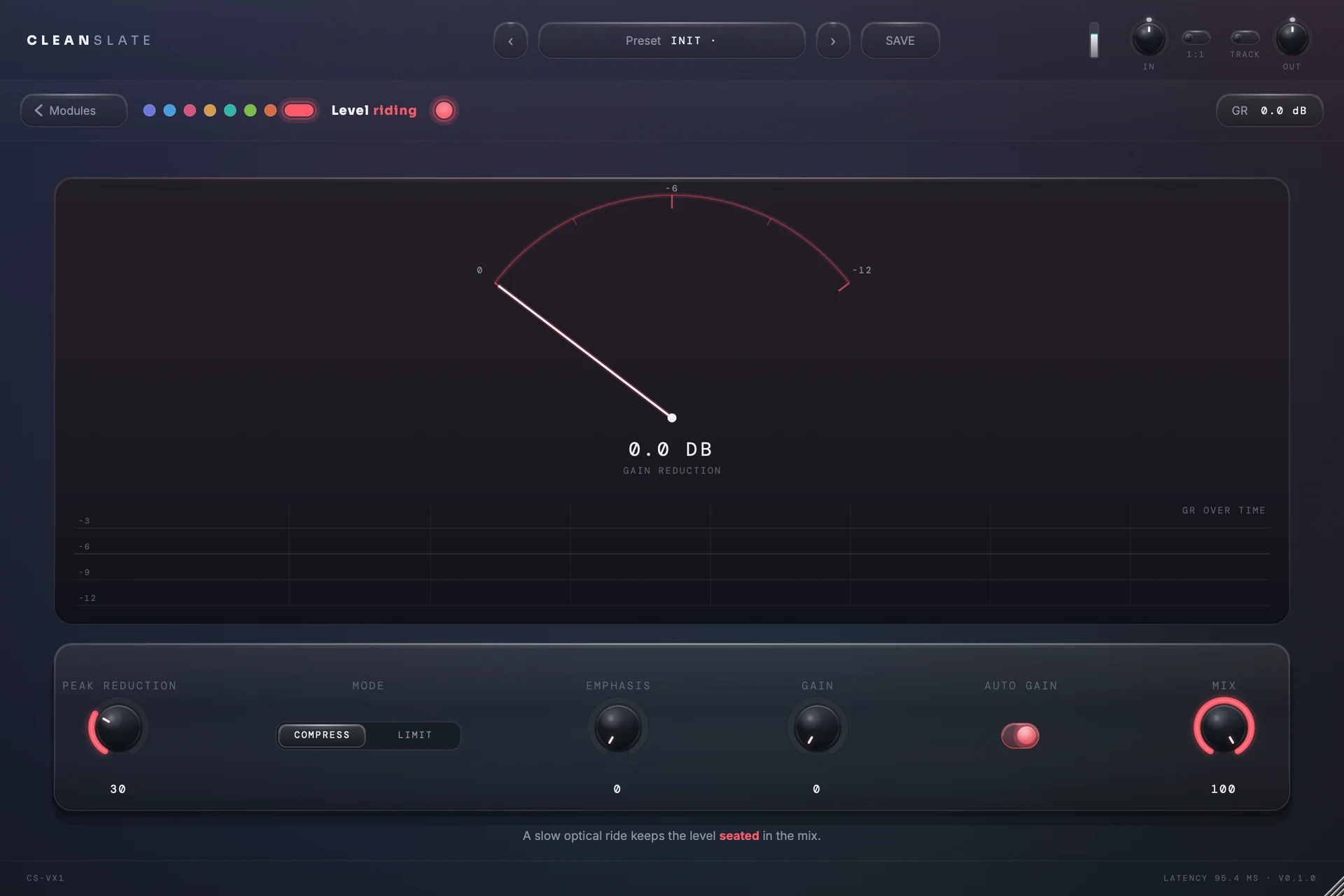
Opto levelling after the catch. Slow, musical, invisible — the reason the vocal never leaves the mix.
Tap for the full story
CLEANSLATE
The boring bits

CLEANSLATE · v1
One licence. Every DAW you own. The whole vocal chain, in the order it should run, in one window. Pay once and the key is in your inbox before you've closed the tab.
50% off for the first 300 buyers
Instant key by email2 machinesWorks offlineMonthly updates
Installers are free to download. The key unlocks them. macOSWindows
Questions
If your DAW loads AU or VST3, yes. Logic, Ableton, FL, Cubase, Studio One, Reaper, Bitwig, Luna and GarageBand are all covered. Pro Tools (AAX) isn't at launch — if you need it, tell us and it moves up the list.
You get a key by email. Enter it once on each machine (up to two), and from then on the plugin works with no internet at all. Deactivate a seat yourself when you change computers. Until a key is entered the plugin passes audio through clean, so a session never goes silent.
Not yet. Everything on this page is the real plugin, recorded through it. If it doesn't do what it says on a vocal you own, write to us within 14 days and we'll sort it.
Yes. We treat a purchase as something to maintain and improve, not something to sell and forget. CLEANSLATE receives one update every month, refining the existing modules and adding new features, with a single aim: the most efficient all-in-one vocal chain for producers and artists.
Updates are free, never ask for your key again, and the plugin tells you when one is ready: press CHECK FOR UPDATE in its footer, or visit badscandal.com/updatecleanslate to see what changed and download the latest build.
That roadmap is shaped by the people using it. Send feature requests or bug reports to contact@badscandal.com and we will address them.
Right here, before or after you buy. The installers are free; the plugin passes audio through clean until a key is entered.
macOS installerWindows installer
macOS 11 or later, Apple silicon and Intel, signed and notarised by Apple. Windows 10 or later, 64-bit. Your key also arrives with both links in the email.
01 · Noise
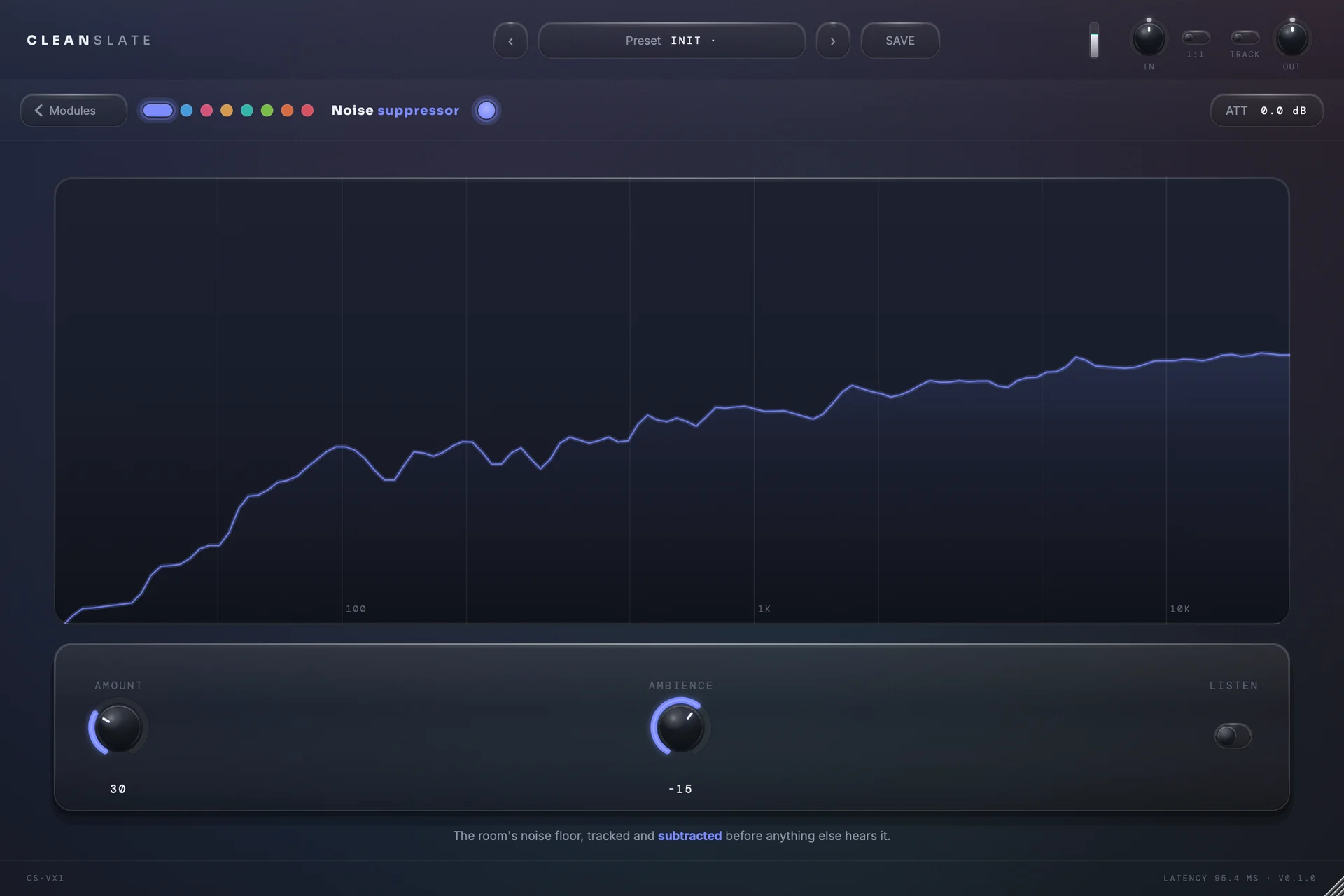
An adaptive noise suppressor that tracks the room's noise floor and subtracts it before anything else in the chain hears it.
It listens to the spectrum continuously and builds a model of everything that is not the voice: air conditioning, computer fans, hum, hiss. That model is subtracted between and under the words, and what remains in the pauses is a steady, natural room tone rather than a gate opening and closing. There is no learn button to press and nothing to arm mid-take.
The gain rule is the same class of speech-enhancement mathematics used in broadcast and forensic tools, tuned for sung vocals rather than speech. Held notes lose almost nothing (measured erosion of 0.04 dB on sustained tones), sibilance and breath onsets keep their attack, hum and whine that sit still for a few seconds are absorbed into the noise model, and a comfort-noise bed keeps pauses sounding like a room instead of a vacuum. Everything that is not voice gets quieter; the voice stays exactly where it was.
02 · Cleanup
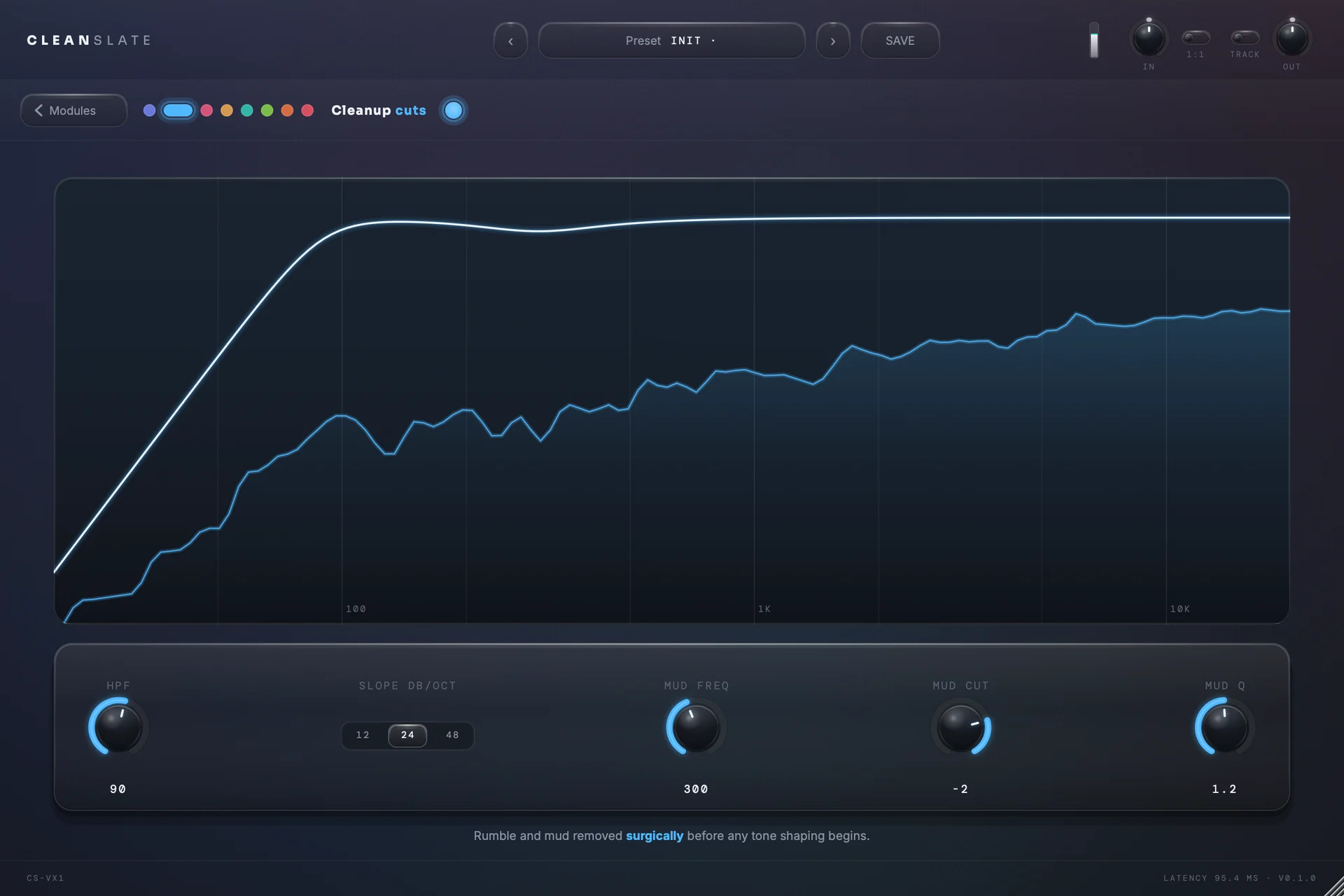
A high-pass filter and a low-mid cut, placed first so every stage after them works on a clean signal.
The high-pass removes handling noise, proximity boom and stand rumble below the voice, at 12, 24 or 48 dB per octave. The mud cut is a single bell in the 150 to 500 Hz region where boxiness lives. Sweeping the corner glides instead of stepping, and changing the slope crossfades between filters so nothing clicks.
These are the two moves every engineer makes on every vocal, done in one place and done precisely: double-precision filters, a corner that glides instead of stepping, and slope changes that never pop in a session. Getting this out of the way early means the compressors and the tape are never fed rumble they would otherwise react to.
03 · Spectral
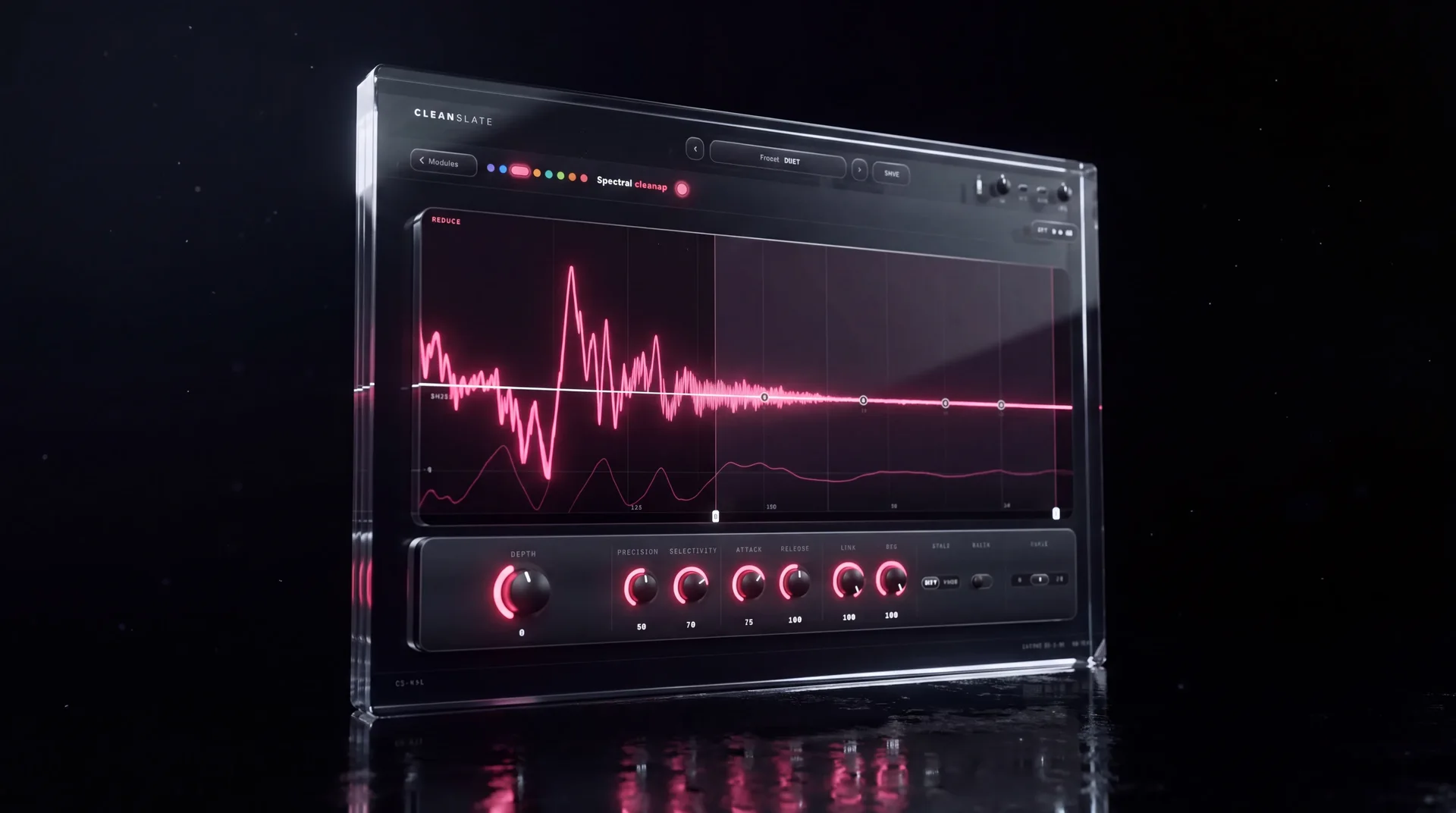
A dynamic resonance suppressor with four nodes that watches your vocal for build-ups and pushes them down as they happen.
You place up to four nodes on the regions where a voice tends to ring: low-mid boxiness, upper-mid harshness, mic and room resonances. Spectral listens inside each region and, when a peak stands out from the harmonics around it, dips exactly that peak by exactly as much as it sticks out. When nothing resonates, nothing is removed. The display shows the reduction being carved in real time.
Calibrated against the industry reference for this kind of processing, so depth, width and timing behave the way experienced engineers expect. Precision narrows each notch toward surgical, Selectivity leaves ordinary harmonics alone and catches only true resonances, and reduction saturates rather than chasing every peak, which is why it stays musical at high depth. A Delta mode plays only what is being removed, so you always know what you are giving up.
04 · Tape
An oversampled tape stage with Character, Steady, Focus and Tube: harmonics, gentle squash and density, without touching the words.
Drive pushes the vocal into a tape model running at four times the sample rate, so the harmonics are clean rather than aliased. Character moves from velvet, a soft tube-like curve that is almost all second harmonic, to crunch, a hard knee with odd harmonics. Speed sets the head bump and the high-frequency roll-off together: 7.5 is thick and dark, 30 is clean and wide. Auto gain keeps the loudness where it was, so turning up drive adds colour, not volume.
Steady is the difference. At 100 a quiet verse gets exactly the same harmonics as a loud chorus, measured at the same distortion figure across a 24 dB range of input, with the level left untouched. Focus band-limits where the warmth is made, so the sub and the air pass around the tape and you can push drive without fizz. A transient guard lets consonants through cleaner than vowels, and the dry path is delay-matched to the wet, so any mix setting is phase-safe.
05 · De-ess
An adaptive de-esser with no attack, no release and no threshold to babysit.
A sibilance detector looks 10 ms ahead of the audio and only opens on the spectral signature of an ess or an affricate, never on a loud dark vowel. The threshold adapts to the performance and freezes during silence and during sibilance itself, so a quiet verse and a loud chorus are de-essed to the same degree. Range sets the most an ess can be turned down; Split dips only the sibilant band and leaves the body alone.
Most de-essers are compressors with a filter in front, and they lisp when pushed. This one approaches the range asymptotically, so loud esses stay proportionally louder than quiet ones and nothing ever goes dead. The lookahead catches the first millisecond of every ess. Air Link feeds its activity to the EQ, lifting the air shelf by up to 3 dB as it works, so taming sibilance no longer dulls the top.
06 · EQ
A twelve-band equaliser with ten shapes, cut slopes to 96 dB per octave and dynamics on any band.
Bells, shelves, cuts, notches, tilt and all-pass shapes, each with its own power, solo and dynamic mode. Dynamic bands compress or expand only their own region, with a band-limited detector and an anti-pump release. Click on the curve to create a band where you point. Scale drags every band's gain at once, from flat to double, so a preset can be dialled back without redrawing it.
The filter mathematics is calibrated so the drawn curve is the curve you hear, with the frequency response verified against a professional reference equaliser. Analog Phase mode matches the phase of the analogue curve as well as its magnitude, with no pre-ringing and zero latency. Any structural change, a band switched on, a shape changed, a slope moved, crossfades in ten milliseconds, so the EQ can be adjusted while the singer is performing.
07 · Catch
A FET compressor in the classic fast style: a fixed threshold, an input you drive into it and ratios you punch in.
The detector sits after the gain stage, in a feedback loop, so it behaves like the hardware: more input means more compression, attack runs down to 20 microseconds, and release is programme-dependent, letting a sustained squash go more slowly than a brief peak. Ratios of 4, 8, 12 and 20 to 1, plus the all-buttons mode with its plateau curve and bite. Output is compensated automatically, so presets carry across levels.
The coloration follows the gain reduction the way a real FET stage does, odd-dominant and growing as you push it, instead of being a static saturation bolted on afterwards. The ratio buttons couple slope, threshold and knee together as one system, so each setting has its own character rather than being a number. Auto gain keeps the level honest while you find the sound.
08 · Level
An optical leveller after the catch, modelled on the classic two-knob studio compressor.
Peak Reduction sets how much the performance is levelled. A light-dependent cell model gives programme-dependent attack and a two-stage release that recovers half quickly and the rest slowly, following the last several seconds of the performance. Compress is a gentle 3 to 1; Limit is near-hard for catching peaks. Emphasis makes the detector more sensitive to brightness, so harsh moments trigger levelling sooner. Tube colour sits outside the loop, level-tracked.
This is the stage that keeps the vocal in the mix without anyone hearing it work. The release memory means a long phrase and a short shout are treated differently, the way the original hardware does it, and consonants pass through untouched. With the fast compressor catching peaks in front of it, Level only ever has to do the gentle part.